From India
Srinivasa Ramanujan
Largely self-taught, he wrote to G. H. Hardy at Cambridge in 1913 with pages of startling formulas. Hardy said some were so strange they had to be true, because nobody could have made them up.
1729 is the Hardy–Ramanujan number: the smallest number that is a sum of two cubes in two ways, 1³ + 12³ = 9³ + 10³. Ramanujan spotted it when Hardy called his taxi number dull.
India celebrates National Mathematics Day on 22 December, his birthday.
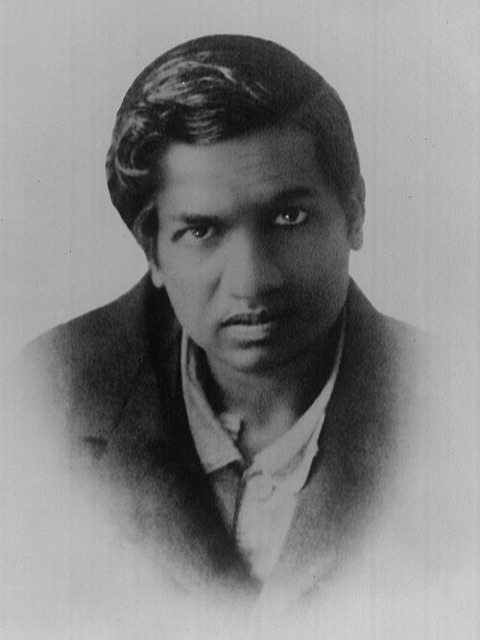
Unknown author, CC BY 4.0, via Wikimedia Commons (resized)
Where you’ll meet Ramanujan here
They turn up beside problems and lessons on these topics.
You might also like
Brahmagupta
His Brahmasphutasiddhanta (628 CE) sets out rules for calculating with zero and negative numbers.
His identity shows that multiplying two sums of two squares gives another sum of two squares, which is useful for this month’s research question.
Brahmagupta’s identity, 628 CE
No portrait of Brahmagupta survives, so we show the mathematics instead.